
Written by IIS Isa Conti Eller Vainicher
From the valorisation of fish-processing waste to the production of bioactive molecules: the BYTHOS project is testing a model of circular economy in Lipari that combines innovation, sustainability and local development. At the heart of the initiative is the FRAP Unit, a facility dedicated to transforming fish-processing residues into new resources for the cosmetics, pharmaceutical, nutraceutical and aquaculture sectors.
When we talk about the blue economy, our thoughts naturally turn to the sea as a source of resources and opportunities: fishing, aquaculture, coastal tourism, renewable energy and marine biotechnology. But there is another equally important dimension to the relationship between the economy and the marine environment: the ability to avoid wasting what has already been produced, transforming materials considered waste into new resources.
This is precisely the perspective underpinning BYTHOS, a project supported by the Interreg Italy-Malta Programme and led by the University of Palermo. With funding of approximately €2 million under the Interreg V-A Italy-Malta 2014–2020 Programme, the initiative has developed a model in which scientific research, technological innovation and the production system can work together to build a more sustainable value chain.
From waste to biomolecules: the innovation challenge
One of the most innovative aspects of BYTHOS is its new approach to managing fish-processing residues. A significant proportion of processed fish is not intended for human consumption and can become a cost for businesses and an environmental issue if it is not properly recovered and valorised.
The project therefore starts from a simple but strategic question: can what is currently considered waste be transformed into a high-value raw material?
The answer explored by BYTHOS is yes; as affirmed Dr. Broni Hornsby, Project Manager For Eu-Funded Projects And Co-Founder Of Bythos Biotech Srl. Through treatment and valorisation processes, fish-processing waste can be used to obtain bioactive molecules (BAMs), compounds with characteristics of interest for a range of industrial applications.
The value of the innovation therefore lies not only in the technology used to recover these materials, but also in the development of a circular model: the residue of one value chain becomes the input for another, reducing waste while creating new economic opportunities.
Why are BAMs so important?
Bioactive molecules are one of the most interesting areas of research developed within BYTHOS. The biodiversity of fish species found in the Sicily-Malta area provides an extremely diverse raw material from which compounds with potential applications in different fields can be obtained.
Among the properties being studied are antibacterial and antimicrobial activities, while some molecules are also being investigated for potential applications in the nutraceutical and cosmetics sectors.
This means that waste is not simply recovered and reused in a less environmentally harmful form: it can become the starting point for products and applications with high added value.
This perspective is particularly relevant for sectors in which the search for new raw materials and compounds is strategically important. Cosmetics, pharmaceuticals, nutraceuticals and aquaculture can thus become part of an integrated value chain in which marine resources are used more efficiently.
Lipari: a laboratory for a new model
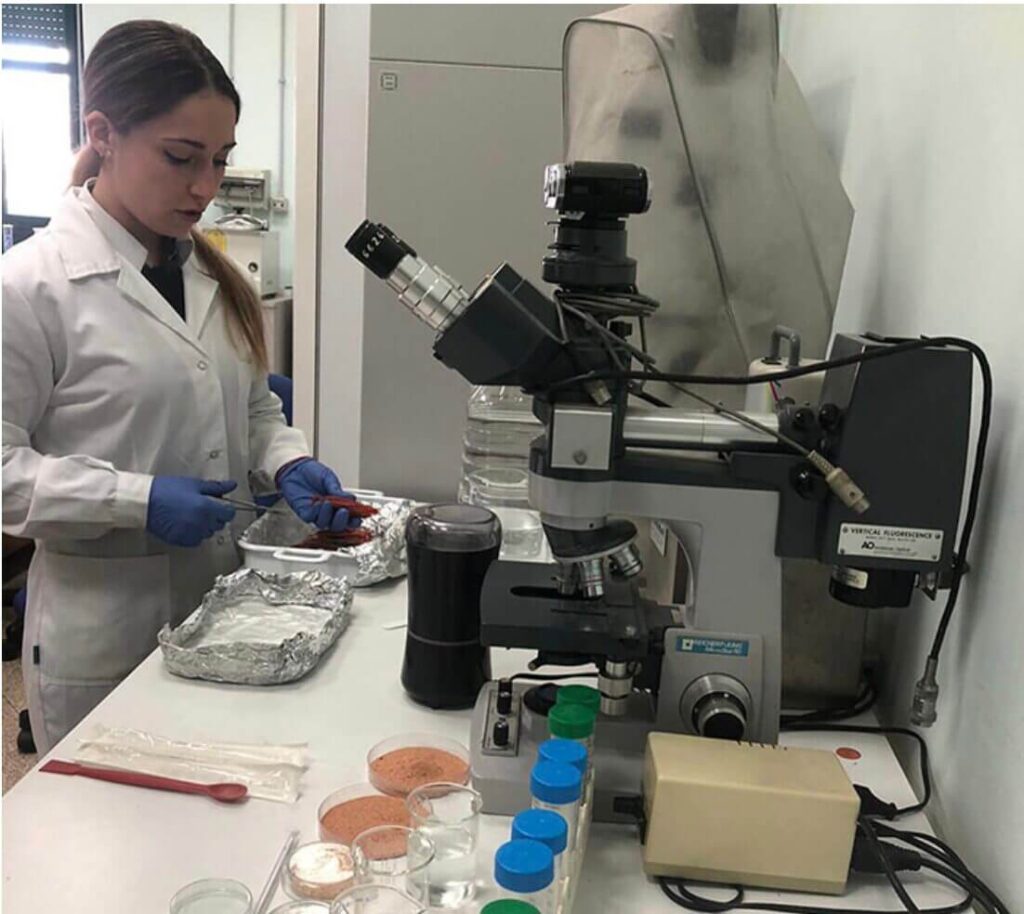
It is in this context that the FRAP Unit, or Fish Residue Automated Processing Unit, was established in Lipari, in the Aeolian Islands. The facility represents one of the most significant elements of the project: a joint laboratory where research and technology come together to develop new approaches to the treatment and valorisation of fish-processing waste.
The choice of Lipari also has an important territorial dimension. Establishing a research facility on a small island means turning a territory that is geographically distant from major industrial and university centres into a place where innovation and new production opportunities can be tested.
The FRAP Unit is therefore much more than a laboratory: it is an example of how research can be brought closer to local communities and their specific production systems, creating stronger links between the scientific world and businesses.
The territorial dimension: businesses and local value chains
A circular economy project can only succeed if it involves the entire value chain. For BYTHOS, this means establishing connections between those who generate fish-processing waste, those with the scientific and technological expertise needed to valorise it, and those capable of transforming the resulting raw materials into products and applications.
The involvement of local industries and businesses is therefore strategically important. The availability of fish-processing residues, knowledge of local production systems and the possibility of directly testing new solutions all help to establish closer relationships between research and the productive sector.
Another objective is to strengthen local value chains. Part of the recovered material can be used to produce innovative feed for aquaculture, helping to reduce dependence on raw materials supplied from outside the region.
The resulting model is one in which value is kept within the territory as much as possible: fishing and fish-processing waste becomes a resource for new economic, scientific and productive activities.
From the project to a long-term perspective
The real test for an innovative project is not only its ability to produce results during the funding period, but also its capacity to leave behind skills, infrastructure and new partnerships capable of lasting over time.
From this perspective, BYTHOS can be seen as an experience in the transition towards a model in which environmental sustainability also becomes economic and employment sustainability.
Waste valorisation can contribute to reducing organic waste while simultaneously opening new markets linked to marine biotechnology. The availability of specialised facilities and expertise, such as those developed around the FRAP Unit, also creates a favourable environment for research, experimentation and collaboration between universities, businesses and institutions.
The most important outcome, therefore, is not necessarily a single product, but the creation of an innovation ecosystemcapable of generating further applications in the medium and long term.
BYTHOS and the new blue careers
The transformation of the blue economy is not only about technologies and production processes. It is also about the people and skills needed to drive this transformation.
This is where the concept of blue careers comes into play. The growth of marine biotechnology, the circular economy and technologies for the valorisation of fishery resources requires professionals able to work across different disciplines: marine biology, biotechnology, chemistry, engineering, environmental management, economics and innovation.
A project such as BYTHOS can contribute to creating this interdisciplinary environment by providing opportunities for training, research and experimentation, while demonstrating in practical terms how skills related to the marine environment can translate into new professional opportunities.
This perspective is particularly relevant for island territories, where the relationship with the sea is a structural component of both the local economy and identity. The objective is not simply to create jobs, but to foster qualified skills and new professional profiles capable of supporting the transition towards more circular and sustainable production models.
Lipari as a circular economy laboratory
Ultimately, the value of BYTHOS lies in its ability to bring together dimensions that are too often considered separately: environmental protection, scientific research, technological innovation, economic development and employment.
The experience of the FRAP Unit demonstrates how an island territory can become a laboratory for testing solutions that can potentially be applied to broader value chains. Fish-processing waste ceases to be merely a problem to be disposed of and becomes a potential source of new raw materials.
This is the logic of the circular blue economy: not simply to use more of the sea’s resources, but to learn how to use them better, reduce waste and preserve their value for as long as possible.
BYTHOS therefore offers a vision in which the sea is not only a source of natural resources, but also a space for innovation. And Lipari, through the FRAP Unit, becomes a concrete place where this vision can be tested: a circular economy laboratory capable of connecting research, businesses, local communities and new skills to help build the blue careers of the future.